
Little dogs · Thoughtful choices
Looking for a “teacup” Maltese?
You’re welcome here—even if you’re still learning the words.
If you’re dreaming of a small companion to share your days, I understand. Let’s talk about what “teacup” means, how Maltese size varies and how to choose the individual puppy who fits your life.

I understand the question
I searched for “teacup,” too
When I first looked for a Maltese, I used that same search term. I wanted a small dog that could easily be carried around with me at all times without throwing my back out! I hadn’t yet learned the breed’s size terminology, so I understand why people ask.
The words and the numbers
One Maltese breed, individual differences
What “teacup” means here
People often use “teacup” when they mean a very small Maltese. The official AKC Maltese standard does not define a separate teacup size category. Maltese are already toy dogs.
The label alone does not tell you a puppy’s adult weight, health or temperament. Ask about the puppy behind the description.
The official standard
The AKC standard specifies weight under 7 pounds, with 4–6 pounds preferred. It places overall quality ahead of size.
Read the official AKC standard
Explore our Maltese breed-standard page
Small is still special
Smaller puppies at Storybook
My usual size focus is around 4–7 lb. Occasionally, I have smaller puppies, including the 3–4 lb range. My priority is the individual dog’s health, temperament and fit with a family—not producing the smallest possible puppy.
When a very small puppy comes along, I take extra care with health evaluation and finding a home prepared for that puppy’s needs. A smaller size is a reason for an individual conversation, not a judgment about the puppy.
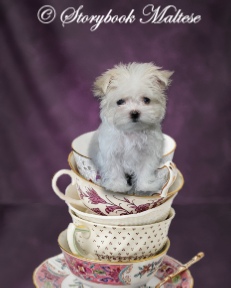
Room to grow
An estimate is a guide, not a promise
Current weight, age, growth so far and family background can be part of the size conversation. They do not guarantee an exact adult weight. A young puppy—and a photograph—cannot give you a final number.
Ask about this puppy
How old is the puppy? What is the current weight? What information supports the adult-size estimate, and what could still change?
Picture your everyday life
Talk about children, other pets, handling, your routine and the care a small companion will need. A good match is about more than a number on a scale.
Look at the whole dog
Ask about health examinations, the parents’ available records and the support you can expect after homecoming. Keep health and temperament at the center of your decision.
Make yourself at home in the Learning Center
My book brings together my experience with daily care, settling in and raising a toy breed. Use the chapter contents and topic search to find the part you need.